
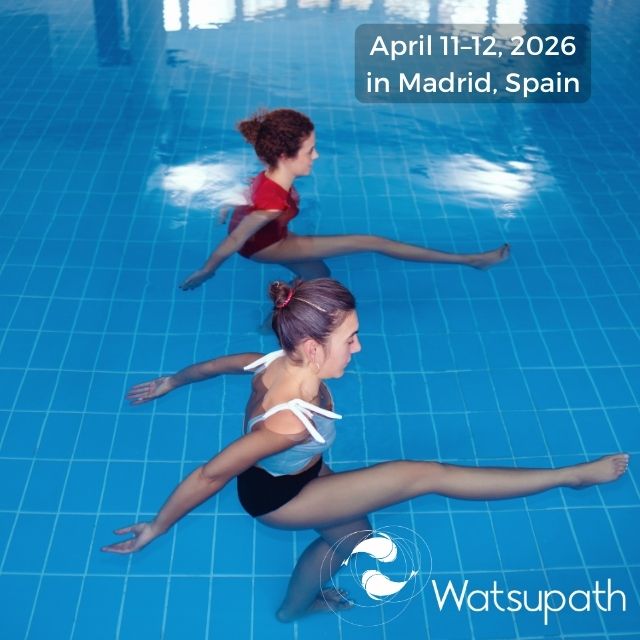
Taught by Elisa Muñoz Blanco.
April 11–12, 2026, at Hospital Fundación San José, Madrid, Spain.
(16 hours accredited by the Watsupath™ Training Institute https://watsupath.com and the Worldwide Aquatic Bodywork Association W.A.B.A. http://waba.pro for the Watsu® professional training path)
Aquatic physiotherapy is a specific area of intervention within physiotherapy, with cross-cutting applications in multiple clinical contexts. The aquatic environment offers particular physical conditions—buoyancy, hydrostatic pressure, resistance, and support—that modify the demands of movement and allow for therapeutic approaches that complement work on land.
This basic course, Clinical Introduction to Aquatic Physical Therapy, is designed as a structured and up-to-date introduction to the physical, physiological, and clinical principles that underpin intervention in water. It is aimed at both physical therapy students at any level and physical therapists, including professionals who already work in the aquatic environment and wish to expand, review, or contrast their practice from a clinical, scientific, and contemporary perspective.
The program integrates the fundamentals of applied fluid mechanics, therapeutic exercise in water, an approach to specific methods in aquatic physical therapy, and an introduction to Craniosacral Therapy in Water™ (CST in Water™), all within a framework of safety, bioethics, and professional standards, aligned with the international recommendations of the IOAPT.
Course objectives
- Upon completion of the course, participants will be able to:
- Understand the physical properties of water and its influence on human movement.
- Recognize the fundamentals of fluid mechanics applied to aquatic physical therapy.
- Identify the basic principles of therapeutic exercise in an aquatic environment.
- Become familiar with specific methods used in aquatic physical therapy (WATSU®, Ai Chi®) from a clinical and evidence-based approach.
- Learn the general principles of Craniosacral Therapy in Water™ as a regulatory approach in the aquatic environment.
- Acquire basic criteria for safety, bioethics, and professional competence when working in a pool.
- Begin to develop clinical reasoning in the aquatic environment, applying the concepts learned to simple situations.
This course offers a solid and structured training foundation that allows you to understand the fundamentals of aquatic physiotherapy and promotes the progressive construction of further learning, both in the academic field and in professional development.
Original price
400€
Early bird price
360€
400.00€Read more
Students are required to pay a facility fee of 36,30€/day to access the pool and use the group room for land classes. The total fee for the two days is included in the final price and will be detailed in the invoice delivered at the end of the course.
COURSE CONTENT (2 DAYS, 16 HOURS)
On-site format.
Theoretical section (6 hours)
- Introduction to aquatic physiotherapy and its professional framework.
- Fluid mechanics applied to physiotherapy: flotation, hydrostatic pressure, resistance, stability, and movement control.
- Physiological effects of immersion.
- Basic principles of therapeutic exercise in the aquatic environment.
- Introduction to specific methods in aquatic physiotherapy.
- General principles of Craniosacral Therapy in Water™.
- Safety, bioethics, and basic professional skills of the aquatic physiotherapist.
Practical section (10 hours)
- Guided bodily experience in the aquatic environment.
- Observation and basic analysis of movement in the pool.
- Supervised application of simple therapeutic exercises.
- Practical introduction to aquatic methods from the perspective of the physical therapist.
- Exploration of flotation, body management, and safe therapeutic contact.
- Basic integration of content through examples and clinical situations.
Skills introduced
During the course, students are introduced to:
- observation of movement and posture in the aquatic environment,
- understanding the effect of the aquatic environment on the body and motor control,
- basic and supervised application of therapeutic exercise in water,
- recognition of different approaches and methods of aquatic intervention,
- identification of safety criteria, professional limits, and good clinical practices.
Competencies are addressed at an introductory level, in accordance with the basic and formative nature of the course.
TEACHING METHODOLOGY
The course combines:
- theoretical presentations with scientific support,
- practical demonstrations in the pool,
- guided and supervised practice among participants,
- simple analysis of clinical situations,
- spaces for reflection and questions.
The methodology is geared towards learning from experience, with a progressive, reflective approach adapted to the level of the students.
Professional and ethical framework
The course is developed in accordance with:
- the principles of evidence-based physiotherapy,
- safety and professional ethics criteria,
- the international standards of the International Organisation of Aquatic Physiotherapists (IOAPT),
- and the competency framework specific to physiotherapy.
STUDENT PROFILE
- Physical therapy students from any year who are interested in learning about and understanding the aquatic environment as a therapeutic setting.
- Physical therapists who wish to begin practicing aquatic physical therapy from an up-to-date and well-founded basis.
- Professionals who already work in the aquatic environment and wish to expand, update, or compare their practice from a clinical, scientific, and contemporary perspective.
No prior knowledge of aquatic physical therapy is required. This class will be taught in Spanish and English translation can be provided upon request.
CERTIFICATION
At the end of the workshop, a Certificate of Participation will be awarded by the Watsupath™ Training Institute, the only training institute in Spain accredited by the W.A.B.A. Worldwide Aquatic Bodywork Association for the Watsu® professional training path.
TEACHER PROFILE
Elisa Muñoz Blanco is a physical therapist, university professor, and clinical researcher with more than two decades of experience exploring how the body organizes life, pain, and resilience. Her work integrates evidence-based physical therapy, psychosomatics, neurophysiology, and advanced aquatic therapies from a systemic, sensitive, and deeply embodied perspective.
She is the creator of Craniosacral Therapy in Water™ (CST in Water™) and founder of the Watsupath Training Institute™, an international space for research, clinical practice, and knowledge transfer. She is one of the few instructors accredited to teach Clinical Watsu® 3, noted for her contribution to the approach to fascia as a system, the integration of trauma, and self-regulation processes in the aquatic environment.
A specialist in pediatric physical therapy, psychotherapy, and advanced manual therapy, she combines clinical practice with university teaching and scientific research, actively participating in publications and international conferences. Her teaching and accompaniment style is characterized by precision, listening, and respect for the rhythms of the body, embodying a curious, complex, and creative mind, committed to clinical excellence and deep care for people.
SCHEDULE
Begins on Saturday, April 11, 2026, at 8:30 a.m. and ends on Sunday, April 12, 2026, at 5:00 p.m.
Total duration: 16 hours
Distribution:
6 hours of theory
10 hours of practical training in the pool
We recommend arriving at least fifteen minutes before the start of class to complete your registration and familiarize yourself with the facilities. All scheduled hours are required, so please do your best to be on time at the beginning and organize your return home so that you can stay until the end of the course. Any missed training hours must be made up with individual supervision.
REGISTRATIONS
The registration fee is 400,00 €. See below for bonus.
Includes: attendance during class hours, teaching materials, and W.A.B.A. registration fee.
Does not include: pool usage fee, travel expenses, accommodation, and meals (see details below).
Registrations will be accepted on a first come – first served basis. The registrations will be valid only upon completion of the Registration Form and online deposit.
BONUS
- Early bird discount: The first 5 students to complete their registration will receive a 10% discount. Not cumulative with other discounts. Coupon: introfta
CANCELLATION POLICY
If, after registering for the course, a participant needs to cancel their enrollment, the following conditions will apply:
-All cancellations must be requested in writing (by email to info@watsupath.com).
-Cancellations requested more than 30 days prior to the start of the course will be eligible for a refund of the amount paid, minus a €100 administrative fee.
-Cancellations requested less than 30 days prior to the start of the course are not eligible for a refund. However, the amount paid may be converted into a credit for a future course, provided that it is taught by the same instructor, takes place at the same facility, and is offered under the same training and financial conditions.
The organization reserves the right to exceptionally assess duly justified cases of force majeure.
In the event that the course is cancelled by the organization, the full amount paid will be refunded, without any additional compensation.
COURSE LOCATION, FACILITY FEE, AND LUNCH
AQUATIC THERAPY UNIT OF THE SAN JOSÉ FOUNDATION HOSPITAL
C/ Pinar de San José, 98
28044 MADRID.
www.fundacioninstitutosanjose.es
Facility Cost:
The San José Foundation Hospital will make its Aquatic Therapy Unit available to students enrolled in this course. The fee for use of the facilities is €36.30 per day (VAT INCLUDED), payable through our payment gateway when you register, and will be itemized and included in the final invoice.
Lunch:
The San José Foundation cafeteria offers a simple menu every day. Salads, sandwiches, and hamburgers are also available for purchase in the cafeteria.
The dining room set up for the group is equipped with a microwave, so you can bring your own lunch if you wish. The areas designated for lunch and snacks in the hospital gardens are a pleasant place to take a break, weather permitting.
HOW TO GET TO THE COURSE VENUE
AQUATIC THERAPY UNIT OF THE SAN JOSÉ FOUNDATION HOSPITAL.
https://goo.gl/maps/nBpnxc2deLu
CAR:
M-40 exit 30, Cuatro Vientos
M-45, towards N-V, M-40 _exit 30
M-30, towards N-V, Cuatro Vientos exit
CITY BUS:
From Aluche (connection with metro line 5 and C-5 commuter train): 483 and 487 towards La Fortuna.
From Plaza Elíptica (connection with metro lines 6 and 11): 486 towards La Fortuna.
METRO:
Line 5 (light green) towards Casa de Campo. Get off at Aluche (link with bus).
Line 11 (dark green) towards La Peseta. Get off at La Peseta and walk 15 Min.
TRAIN:
RENFE operates regular train services to Madrid.
By commuter train: Line C-5 (yellow), towards Móstoles – El Soto. Get off at Aluche (link with bus).
PLANE:
Madrid-Barajas Airport.
FOR FURTHER INFORMATION, PLEASE CONTACT
Watsupath™ Training Institute
e-mail: info@watsupath.com